Her tone carried the familiar implication that my concern was excessive, that my vigilance was theatrical, and although I opened my mouth to insist on accompanying them, I hesitated because I did not want to ignite another round of eye-rolling glances or quiet remarks about my so-called sensitivity.
My husband, Colton, was leaning against the deck railing with a bottle of beer in his hand, laughing at something his father had just said, and when I searched his face for some sign that he would notice my unease, he avoided my gaze as though nothing of consequence were unfolding.
Minutes passed, and at first there was nothing unusual in the sounds drifting from the yard beyond the hedges: the hum of distant traffic, the clatter of silverware against ceramic plates, the murmur of adult conversation carried lazily by the breeze. Then the tone shifted.
It was not the high-pitched protest of a child refusing to share a toy, nor the exaggerated wail meant to draw attention; it was a sharp, desperate cry that sliced through the air and lodged somewhere deep in my body before my mind could form a thought.
“Marlowe!” I shouted, already moving toward the back gate.
The sunlight struck my face as I rounded the corner of the house, and what I saw rooted me to the ground for half a second that felt endless. Near the old apple tree at the edge of the property, Marlowe stood with her arms flailing, her small body twisting in confusion and fear, while a dense cloud of buzzing insects circled around her like a living storm.
The sound was overwhelming, a frantic vibration that swallowed her sobs, and she was crying in a way I had never heard before, a broken, gasping sound that did not belong in a child’s mouth.
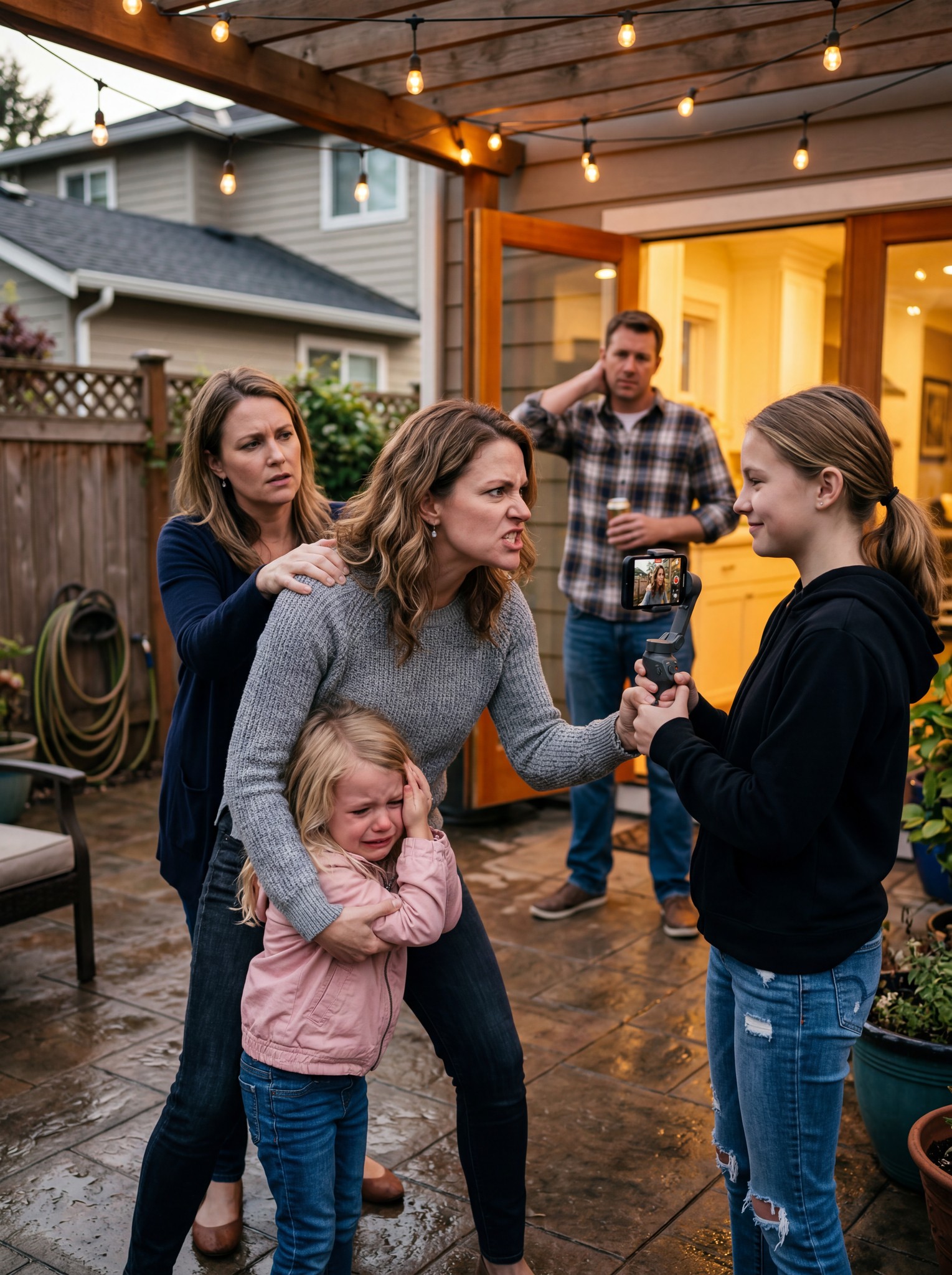
A few feet away, Tessa stood with her phone raised, angling it carefully as though she were framing a shot for social media, her laughter thin and breathless with excitement.
“Oh my gosh, look at this,” she was saying, barely glancing at me. “It’s just a little challenge. She’ll be fine.”
There was no trace of hesitation in her voice, no awareness that what she was witnessing was not playful discomfort but raw terror.
I ran toward my daughter without thinking, my only intention to reach her and shield her, but before I had taken more than two steps, a sharp force jerked my head backward. Beverly had grabbed a fistful of my hair and pulled hard enough that my balance vanished, and I stumbled onto the grass with a jolt that knocked the breath from my lungs.
“Stop it,” she snapped, her voice no longer sweet. “Tessa is having fun. Don’t ruin it.”
For a moment, the world narrowed to fragments: the sting along my scalp, the taste of dirt in my mouth, the relentless buzzing in the air, and Marlowe’s voice calling for me in short, panicked bursts.
I looked toward Colton, who had finally walked closer but remained at the edge of the yard, his posture stiff and uncertain, as though he were observing an awkward misunderstanding rather than an emergency.
“Colton,” I pleaded, struggling to sit up, “do something.”
He lifted his shoulders in a gesture that was almost apologetic yet utterly detached.
“It’ll be over in a second,” he said. “Don’t make this bigger than it is.”
In that instant, something inside me shifted with a clarity that hurt more than the pull on my hair, because I understood that my daughter and I were alone in a way that had nothing to do with physical distance.