In the footage, they exited the gate and headed toward the bus stop. They boarded a city bus together.
Then they disappeared from view.
“I need to talk to Maya,” I said to the principal. “Is that possible?”
“Maya isn’t enrolled here anymore.” She pointed at the screen. “She transferred suddenly. That was her last day.”
I drove straight to Maya’s house.
A man answered the door.
“Can I speak with Maya, please? She was with my son the day he disappeared. I need to know if he mentioned anything to her.”
The man studied me silently for a moment. Then something in his expression hardened.
“Maya isn’t here. She’s staying with her grandparents for a while.” He started closing the door, then paused. “I’ll ask her if she knows anything.”
I stood there uncertainly, a feeling deep in my gut telling me I should push further — but I didn’t know how.
Then the door closed.
The weeks that followed were the most painful of my life.
We printed flyers, posted on every community board, and shared Daniel’s photo across social media.
The police searched too, but as months passed their efforts faded. Eventually people began referring to Daniel as a runaway.
But I knew my son.
Daniel wasn’t the type to disappear without a single word.
And no matter how long it took, I would keep searching.
Almost a year later, I was in another city for a business meeting. Slowly, I had forced myself back into something resembling normal life — work, grocery runs, Sunday phone calls with my sister.
After the meeting ended, I stopped at a small café for coffee.
While I waited at the counter, the door opened behind me. I turned.
An elderly man shuffled in slowly, bundled against the cold, counting coins in his palm. He looked like he might be homeless.
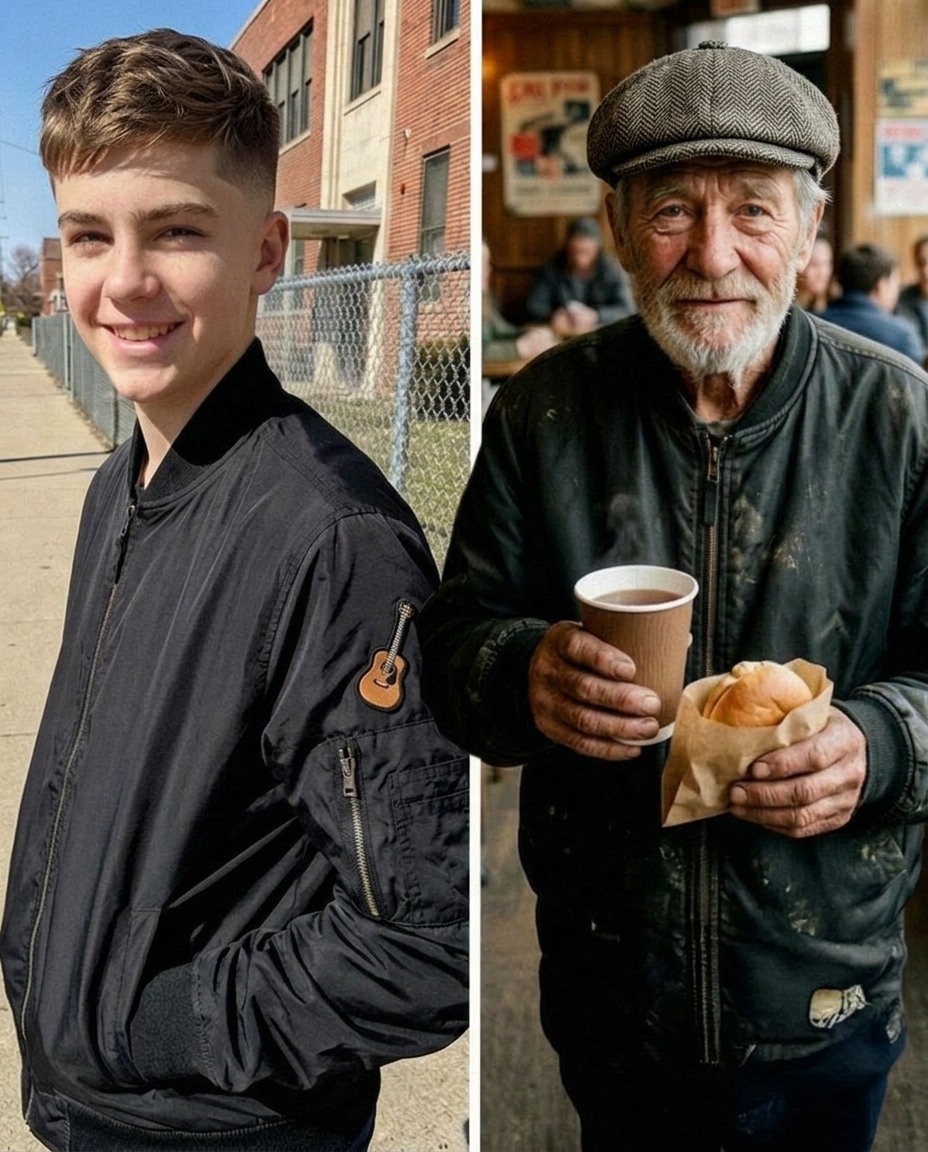
And he was wearing my son’s jacket.
Not a similar one — the exact same jacket Daniel had worn the morning he disappeared.
I knew immediately because of the guitar-shaped patch covering a torn sleeve. I had sewn that patch myself. I also recognized the small paint stain on the back when the man turned to order tea.
I pointed toward him. “Add that man’s tea and a bun to my order.”
The barista glanced at him, then nodded.
The old man turned toward me. “Thank you, ma’am, you’re so—”
“Where did you get that jacket?”
He looked down at it. “A boy gave it to me.”
“Brown hair? About sixteen?”