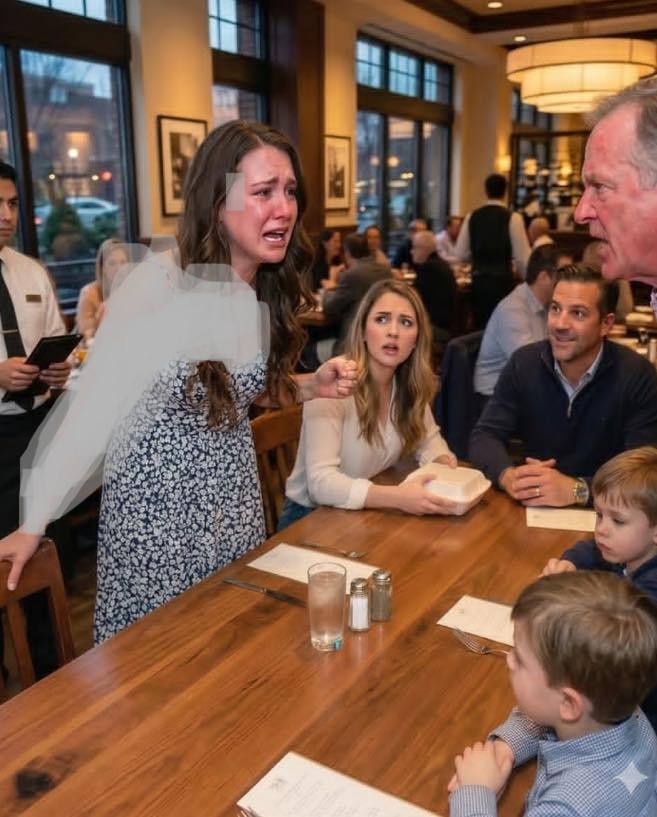
But humiliation had already spoken enough. I chose facts.
“You’re right,” I said. “No one owes me dinner. But grandparents who watch some grandchildren sit hungry while others take home leftovers are making a choice. And I’m finally paying attention to that choice.”
Emma’s fingers found the back of my sweater. Lily stood too, pressing close to my side. I rested a hand on each of them and felt how small they still were.
Dad pushed his chair back. “I will not be lectured in public by a woman who can’t manage her own life.”
There it was—the line he always used when he wanted to tear me down: not a mother trying her best, not a working woman rebuilding after betrayal, but a failed adult whose suffering proved her inferiority.
Usually, that line still hurt. This time, it clarified everything.
“My life is managed,” I said evenly. “What I don’t manage anymore is disrespect.”
Rebecca rolled her eyes. “So now you’re storming out because Dad made a joke?”
“No,” said a new voice from the far end of the table.
We all turned. It was my mother. Elaine Baines had spent most of my life speaking softly, apologizing often, and letting stronger personalities control every room. But now she sat upright, napkin folded in her lap, looking at my father with an expression I hadn’t seen since childhood.
“She’s leaving,” my mother said, “because you humiliated her daughters.”
Dad actually looked taken aback. “Elaine—”
“No.” Her voice trembled once, then steadied. “Not this time.”
The entire table froze.
Mom turned to the waiter. “Please bring two children’s portions of pasta to-go. And put them on my card.”
Dad let out a disbelieving laugh. “You don’t need to indulge this nonsense.”
My mother stood. I had forgotten how tall she seemed when she stopped trying to disappear. “This is not nonsense, Russell,” she said. “This is what you’ve done for years. Rebecca gets generosity. Claire gets judgment. Her girls get crumbs while you call it character-building.”
Rebecca flushed. “Mom, that’s not fair.”
My mother looked at her too. “No. It isn’t.”
Mitchell muttered, “This has gotten ridiculous.”
Aunt Cheryl spoke before I could. “No, Mitch. Ridiculous was two little girls watching your boys take food home while being told to wait.”
The waiter slipped away, clearly relieved to have something practical to do.
Dad looked around the table and saw—maybe for the first time—that silence was no longer backing him. Neil rubbed the back of his neck and said quietly, “Dad… it did look bad.”
“Look bad?” Dad snapped. “Since when are we grading optics?”
“Since always,” I said. “You just only notice when they cost you authority.”
Rebecca stood abruptly. “Can we not turn one dinner into some feminist documentary?”