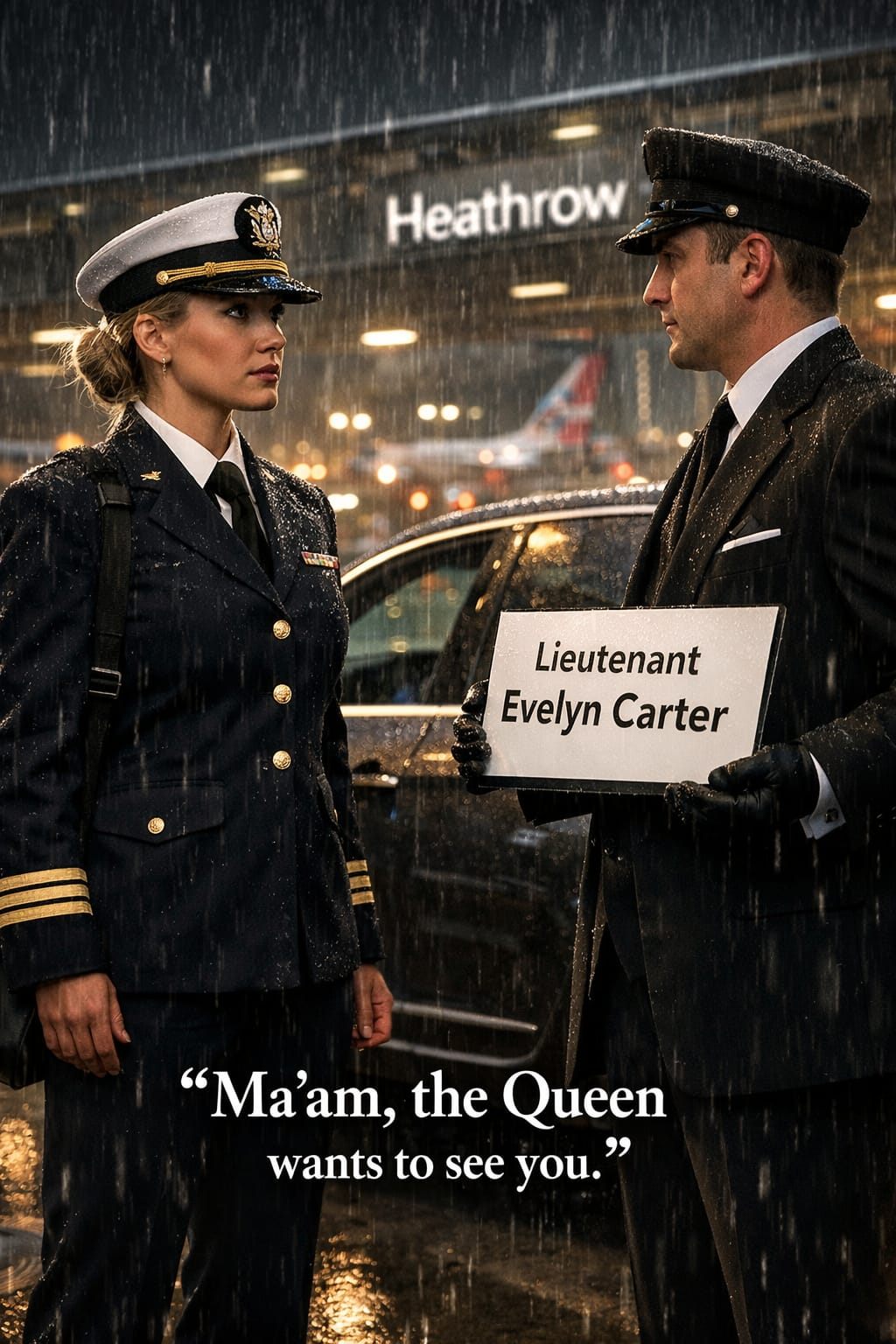
“In certain circles, ma’am, he was regarded as a man of unusual discretion.”
That sounded like something out of a classified briefing, not a eulogy.
As we drove, London unfolded outside my window. The Thames glittered under bridges. Soldiers in red tunics guarded palaces I’d only seen in history books. The city carried the kind of weight that demanded silence.
I thought about Grandpa’s words.
“Duty doesn’t end when the uniform comes off.”
Maybe this was his version of a final salute.
The car turned through iron gates marked with the royal crest. Guards checked credentials, saluted, and waved us through.
My breath caught as Buckingham Palace came into view, its marble façade rising through the mist like something from another time.
Inside, everything was velvet and discipline.
Portraits of monarchs lined the hallways. Every surface gleamed with order and purpose.
I followed the driver through corridors until we stopped before a tall man in uniform, an older gentleman whose bearing reminded me of Grandpa himself.
“Lieutenant Carter,” he said, extending his hand. “I’m Sir Edmund Fairchild, private secretary to Her Majesty.”
His handshake was firm, his eyes keen.
“You must be wondering why you’re here.”
“That’s putting it lightly,” I replied.
He smiled faintly.
“Your grandfather was a man of both duty and secrecy. During the Cold War, he commanded a joint U.S.-U.K. operation that prevented a rather disastrous outcome. Few people know it existed, and fewer still know what it cost him.”
I felt my pulse quicken.
“You mean he worked for British intelligence?”
“In a manner of speaking,” Sir Edmund said. “He was trusted here deeply. In gratitude, Her Majesty offered him a personal commendation, which he declined.”
“He declined?”
“He requested that recognition be deferred.”
“Deferred to when?”
He gestured toward a nearby table.
On it lay a small leather case embossed with both the Union Jack and the American eagle.
“To you.”
Inside was a sealed envelope, a gold medal, and a letter in handwriting I recognized instantly.
Grandpa’s.
Evelyn,
I declined my honor so that one day it could mean something greater. If you’re reading this, it means you’ve earned it—not by rank, but by service. Deliver this medal where it belongs. The Queen will understand.
—H.A.C.
My throat tightened.
The medal shimmered in the soft light, a cross of gold and silver with both nations’ insignias entwined.
Sir Edmund watched me silently.
“Your grandfather wanted you to complete what he began. There is one more file you need to see.”
He handed me a folder marked OPERATION REMEMBRANCE.
Inside were photos of soldiers, both American and British, who had served under Grandpa’s command in humanitarian missions across Europe. Some faces were familiar from old photo albums. Others were strangers.
“These men and women formed the foundation of a veterans’ relief effort,” Sir Edmund explained. “Your grandfather funded it privately for decades. When he passed, it went dormant, but it can be reactivated with your authorization.”
I blinked, trying to absorb the weight of it.
“You’re saying he left me a mission.”
“A legacy,” Sir Edmund corrected gently. “A bridge between our nations, built not with politics, but with service. The Queen wished to thank you personally for accepting that responsibility.”
He opened a side door, and for a heartbeat, I forgot how to breathe.
The room beyond was smaller than I expected. No cameras. No crowd. Just a quiet space flooded with afternoon light.
Standing beside a window overlooking the garden was a woman in a soft blue dress and pearls.
Sir Edmund’s voice softened.
“Ma’am, this is Lieutenant Evelyn Carter.”
Her Majesty turned toward me, her smile gracious yet sharp with intelligence.
“So you are Henry Carter’s granddaughter,” she said, her voice gentle but commanding. “He spoke of you often.”
I stood frozen, years of military training collapsing into instinct. I saluted before realizing how absurd it must look.
She chuckled softly.
“At ease, my dear. We are allies, after all.”
I lowered my hand, heart pounding.
“Your Majesty, I didn’t know—”
“Few did,” she interrupted kindly. “Your grandfather’s service was beyond medals. He believed that true honor is found in quiet acts, not grand ceremonies. I understand you have chosen to continue his work.”
“I… I don’t know yet,” I admitted.
She studied me for a moment that felt like a lifetime.
“Then allow me to offer advice he once gave me. A soldier’s legacy is not what she inherits, but what she carries forward.”
Her words hit with the precision of a command.
When I left the palace, the drizzle had stopped. The driver waited by the car holding an umbrella.
“Where to next, ma’am?”
I looked down at the leather case in my hands.
For the first time, I realized it wasn’t about inheritance. It was about trust.
Grandpa had sent me here not to receive something, but to do something.
“Take me to the archives,” I said quietly. “I need to know what he built.”
As the car pulled away, I saw the Union Jack fluttering in the distance and thought of the American flag folded in my suitcase.
Two worlds. One mission.
And somewhere, I could almost hear Grandpa’s gravelly laugh.
Good girl. You’re not done serving yet.
The archives weren’t what I expected.
I’d imagined dust and silence, something ancient and ceremonial.
Instead, the royal archives beneath St. James’s Palace were alive with quiet precision. Men and women in suits and white gloves moved through aisles of classified boxes marked with faded symbols, old NATO stamps, and a few coded abbreviations I didn’t dare decipher.
Sir Edmund accompanied me, his polished shoes barely making a sound on the marble floor.
“Your grandfather’s materials were sealed in 1984,” he explained. “He left explicit instructions that they were to be opened only by a member of his direct bloodline with active service credentials.”
“That would explain the timing,” I murmured. “He died right before my next deployment.”
“Exactly.”
He stopped before a security terminal. After scanning my passport and military ID, he pressed his hand to the reader. The reinforced door hissed open.
Inside waited a single metal case labeled:
CARTER, HENRY A.
JOINT SERVICE FILE
He gestured.
“It’s yours.”
I lifted the lid.
Inside were handwritten journals, photographs, and a stack of official letters sealed with both American and British insignias. The scent of old ink and tobacco smoke rose from the pages—so distinctly him that I had to blink back tears.
Sir Edmund stood back, giving me space.
“Take your time, Lieutenant.”
The first page of the journal began simply:
If Evelyn ever finds this, tell her that some honors are meant to be earned twice. Once in life, once in memory.
My hands trembled slightly as I turned the pages.
Each entry chronicled operations that never made the history books: evacuations in Berlin, intelligence drops in Eastern Europe, rebuilding missions in war-torn villages.
He’d worked alongside British officers, not as a soldier of rank, but as a friend who believed in the same code.
Leave no one behind.
Tucked in the back was a faded photograph.
Grandpa stood beside a younger Queen Elizabeth, both in uniform, both smiling as if they’d just survived something monumental. Beneath the photo, written in his neat military block letters:
True allies never retire.
I swallowed hard.
“He really was one of them, wasn’t he?”
Sir Edmund nodded.
“Your grandfather’s courage saved lives during a delicate period, but he refused all decorations, insisting the mission remain anonymous. He believed service should speak louder than ceremony.”
I traced my fingers over the photograph.
“Then why me? Why send me here?”
“Because you followed in his footsteps,” Sir Edmund said quietly. “You joined the Navy. You kept your integrity intact in a family that didn’t.”
I looked up sharply.
He didn’t flinch.
“His words, not mine,” he added. “He wanted to pass on something more than medals. He wanted you to understand what duty truly meant.”
He motioned toward another folder, smaller and newer.
“This contains his final request. He asked that it be delivered directly to Her Majesty upon your arrival.”
I frowned.
“What’s inside?”
He gave a diplomatic smile.
“That is above my clearance, Lieutenant.”
The rest of the day passed in a blur of reading, listening, absorbing.
Each document deepened my understanding of who my grandfather really was: a man who used his influence not to seek power, but to protect it.
When we left the archives, dusk had settled over London, and the city glowed like candlelight beneath the fog.
“Her Majesty requests your presence once more,” Sir Edmund said as we reached the car. “She wishes to speak privately.”
The palace gates opened again, but this time the air felt heavier, more reverent. The guards nodded as if they already knew who I was.
A footman led me to a smaller room, richly lit by gold sconces. The Queen stood by the fireplace, hands folded, her gaze thoughtful.
“Lieutenant Carter,” she said. “You’ve seen the records.”
“Yes, ma’am.”
I was standing at attention before catching myself.
“Your Majesty.”
“Formality suits you,” she said with a faint smile. “But please, relax. You’ve inherited enough discipline for two generations.”
I smiled, but it faltered quickly.
“Your Majesty, I don’t understand why my grandfather involved you in all this. He could have just left me a letter.”
She walked closer, her expression softening.
“He knew a letter wouldn’t be enough. He wanted you to feel the weight of service—to know that your family’s legacy isn’t about wealth, but stewardship.”
“Stewardship.”
The Queen nodded.
“Your grandfather helped establish a joint fund decades ago, what we now call the Remembrance Foundation. It was created to support injured veterans and their families across both our nations. When he retired, the fund’s American branch fell dormant. He hoped you would revive it.”
I blinked.
“Me?”
“Who better?” she said simply. “You understand both duty and compassion. The general was clear. His estate was never meant for indulgence. It was meant for impact.”
She stepped aside and gestured to a velvet box on the mantel.
“Inside, you’ll find his commendation. The one he declined.”
I opened it carefully.
The medal shimmered, golden-crimson, engraved with the words:
FOR SERVICE BEYOND BORDERS
I felt a lump rise in my throat.
“Your grandfather’s final wish,” she continued, “was that you accept it in his stead on behalf of every soldier who served quietly without recognition.”
I could barely speak.
“I don’t deserve this.”
The Queen smiled faintly.
“Neither did he, according to himself. That was precisely why he did.”
For a long moment, the room was silent except for the ticking of the clock.
Finally, she extended her hand.
“Lieutenant Carter, may I?”
I nodded.
She pinned the medal to my uniform herself.
The gesture felt impossibly personal. Almost sacred.
When she stepped back, she said softly, “He once told me, ‘My granddaughter will know what to do when the time comes.’ I believe he was right.”
I swallowed hard.
“What am I supposed to do?”
“Go home,” she said. “Serve again, but this time in your own way.”
The words echoed through me as if spoken by both of them—her and Grandpa together.
When I left the palace that night, London glowed beneath the rain. I held the medal in my palm, its weight both unbearable and comforting.
Somewhere across the ocean, my family was probably still celebrating their inheritance, unaware that the one they mocked now carried a legacy signed by the Queen herself.
For the first time, I realized Grandpa hadn’t left me nothing.
He’d left me everything that mattered.
When I returned to my hotel that night, I couldn’t sleep.
The rain tapped gently on the window like the ticking of a clock, urging me to act. Grandpa’s medal lay on the desk beside the sealed folder from the Queen.
The weight of it all pressed against my chest—honor, confusion, and something that felt suspiciously like destiny.
I finally opened the folder.
Inside was a single sheet of parchment, the royal crest embossed in gold.
It read:
The Remembrance Foundation, established jointly under the governments of the United States and the United Kingdom, funded by General Henry A. Carter. In the event of his passing, his designated successor is authorized to resume operations under dual approval.
At the bottom, there was a signature line:
EVELYN CARTER
LIEUTENANT, UNITED STATES NAVY
For a moment, I just stared.
My grandfather hadn’t left me a gift. He’d left me a responsibility.
The next morning, I met again with Sir Edmund and a younger aide named Clara. She brought me tea strong enough to stand a spoon in and a stack of records older than my parents’ marriage.
“Your grandfather funded these operations quietly for decades,” Clara said. “Housing for wounded veterans, scholarships for their children, reintegration programs. It all stopped after an incident in the early 2000s.”
“What kind of incident?”
She hesitated.
“Financial mismanagement. The American trustees—your father among them—froze the foundation’s assets after a dispute. The British half remained intact, but the U.S. side fell silent.”
My pulse quickened.
“My father?”
Sir Edmund nodded solemnly.
“He was granted limited administrative rights through your grandfather’s estate. Unfortunately, he used them to divert funds into personal ventures just shy of illegality. The Queen chose not to intervene out of respect for your grandfather’s privacy, but she believed the day would come when you’d correct it.”
The words struck like a cold wave.
So that was the real reason for the ticket to London.
Grandpa knew his son couldn’t be trusted. He’d sent me to finish what he couldn’t without igniting scandal.
I asked to see the ledgers.
The numbers didn’t lie.
Years of donations had been redirected into shell companies, luxury developments, private investments—all under Carter Holdings.
I felt sick.
Clara’s voice softened.
“We can help you reinstate the foundation. All it needs is your signature as successor. Once reactivated, the U.S. branch will regain control of the assets.”
“But—”
Sir Edmund leaned forward.
“You’ll be declaring open war on your family. Legally, ethically, socially. Are you prepared for that?”
I thought about Grandpa’s flag folded on my nightstand. About the laughter in that Virginia parlor. About Dad’s smug grin when he’d said, Guess he didn’t love you much.
“Yes,” I said quietly. “I’m prepared.”
That afternoon, we went to the Royal Treasury Office to finalize the transfer.
I signed the documents, each stroke of the pen steady as a heartbeat.
When it was done, Sir Edmund handed me a stamped copy of the charter.
“Congratulations, Lieutenant. The Remembrance Foundation now belongs to you.”
“Belongs?” The word felt strange. “It wasn’t mine. Not really. It was everyone’s. But it carried his name, and that meant everything.”
Before I left, Clara slipped a second envelope into my hand.