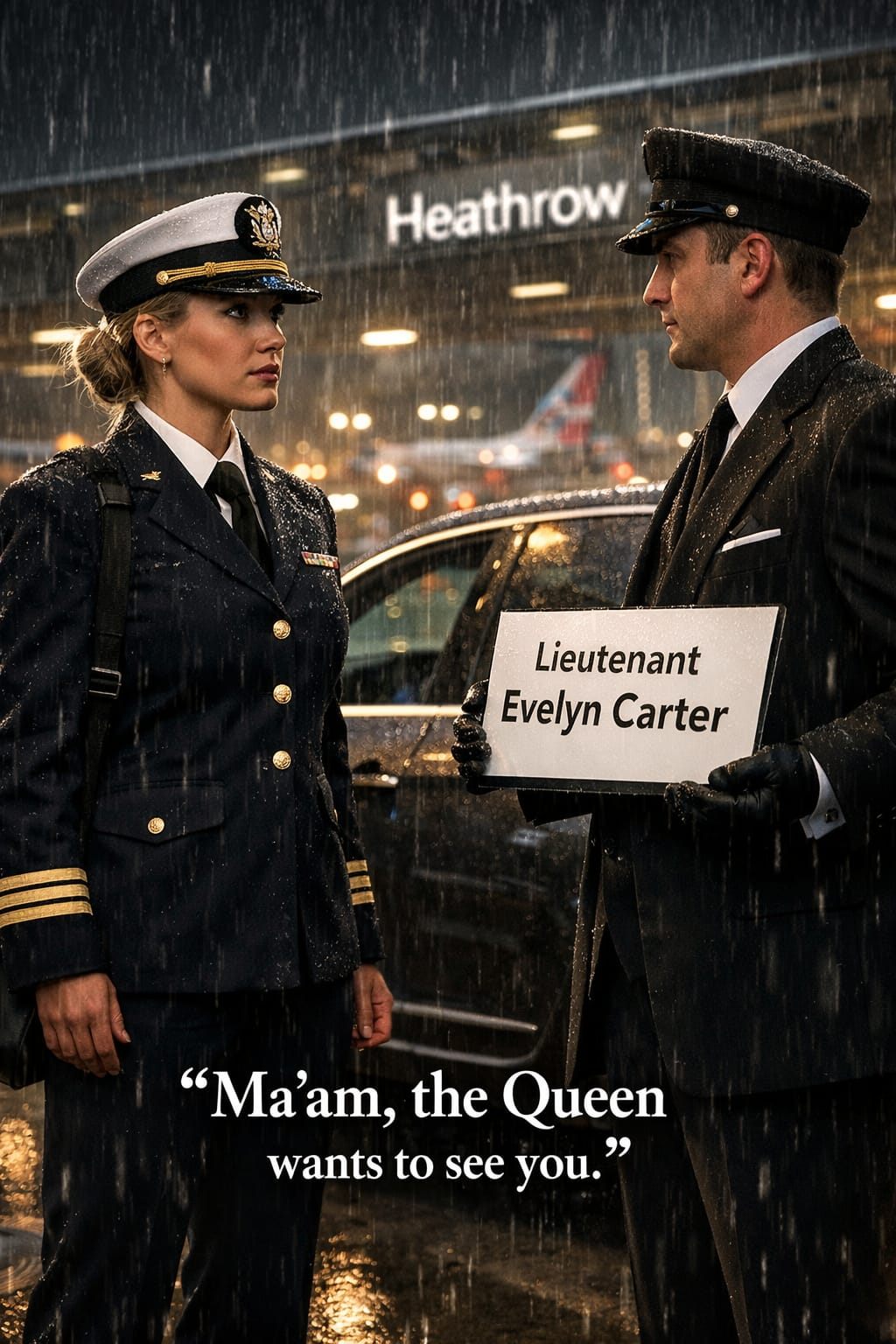
“This came from the late general’s personal safe,” she whispered. “He wanted you to have it once you signed.”
In the cab back to the hotel, I opened it.
Inside was a single photograph.
Grandpa standing with a group of veterans, their hands resting on each other’s shoulders.
On the back, he’d written:
Service never ends, Eevee. It only changes uniforms.
Tears blurred the ink.
That night, I emailed my commanding officer back in Norfolk to request temporary reassignment to the States for family estate matters. I didn’t elaborate.
He replied within hours.
Take the time you need, Lieutenant. You’ve earned it.
When I boarded the return flight the next morning, I carried only three things:
The medal. The charter. And Grandpa’s note.
Everything else—resentment, hurt, confusion—stayed behind in the London fog.
As the plane lifted over the Atlantic, I replayed the Queen’s words in my mind.
Serve again in your own way.
Maybe this was what Grandpa meant all along.
Service wasn’t about obeying orders.
It was about answering the quiet calls no one else could hear.
When the wheels touched down in Washington, I felt something shift inside me.
I wasn’t the forgotten granddaughter anymore.
I was the general’s last soldier.
And my mission had just begun.
By the time I landed back in Virginia, autumn had turned the air sharp and gold.
The Carter estate loomed over the hills like a fortress of pride and polished glass, every stone bought with someone else’s sacrifice.
I hadn’t been home since the funeral.
Dad was waiting in the driveway, coffee in hand, sunglasses reflecting the last light of day.
“Well, look who decided to return from her royal vacation,” he said, smirking. “Did the Queen offer you tea and sympathy?”
I smiled faintly.
“Something like that.”
Mom emerged behind him, perfectly pressed as always.
“You should have told us you were leaving, Evelyn. The neighbors asked where you’d gone. It was embarrassing.”
“I didn’t think it mattered,” I said quietly, stepping past them toward the door.
Inside, the house smelled like polished oak and money. The same family portraits hung on the walls. Grandpa’s military photo right in the center, surrounded by my father’s golf trophies and my brother’s college awards.
His uniform looked out of place among all that ego.
At dinner, they talked about their inheritance like it was a game. Dad described the renovations to the estate, the new vineyard, the imported marble for the foyer. Mom nodded proudly, swirling her wine.
When she finally turned to me, her tone was half amusement, half condescension.
“So, what did you do in London? Sightseeing? Shopping?”
I set down my fork.
“I went to Buckingham Palace.”
The table fell silent for a beat.
Then Dad burst out laughing.
“Right. And I had lunch with the president last week.”
“I met with Her Majesty’s secretary,” I continued evenly. “She asked me to take over something my grandfather started.”
Mom tilted her head.
“A hobby?”
“A foundation.”
Dad raised an eyebrow.
“Oh, for what? Tea parties and old uniforms?”
“For wounded veterans,” I said. “Grandpa founded it with the Queen decades ago. He left it to me.”
Dad’s smirk faltered.
“That’s ridiculous. He never mentioned it.”
“Maybe not to you,” I replied.
For the first time that night, I saw something flicker in his eyes.
Not anger.
Fear.
He looked down at his glass.
“Well, whatever fantasy you’ve built for yourself, I hope it keeps you busy. Some of us have real responsibilities.”
The rest of dinner passed in silence and silverware.
Later, as I stood on the back porch watching the moon rise over the fields, I heard footsteps behind me.
Mom joined me, her arms crossed.
“You don’t have to pretend you’re important, Evelyn. It’s sweet, but you’ll only embarrass yourself.”
I turned to her.
“You know what’s really embarrassing? Having a daughter who served her country and still being ashamed of her.”
Her lips tightened.
“You always were dramatic.”
“No,” I said, stepping closer. “I’m just done apologizing for being something you’ll never understand.”
She didn’t answer.
Back in my old bedroom, the walls were still lined with framed medals and commendations Grandpa had given me over the years.
I pulled out my laptop and opened the encrypted files Sir Edmund had sent.
Everything was there.
The ledgers. The trust deeds. The proof of how Dad had rerouted funds into personal accounts.
My hands shook—not with rage, but with clarity.
It wasn’t revenge I wanted.
It was correction.
The next morning, I drove into Richmond and met with the Carter family’s longtime attorney, Mr. Halloway—the same man who had handed me that envelope at the funeral.
His eyes widened when he saw the royal seal on my briefcase.
“Lieutenant Carter,” he said, standing. “I must admit, I didn’t expect to see you again.”
“I need you to process some paperwork,” I said, sliding the documents across his desk.
He put on his glasses and read in silence.
“You’re reinstating the Remembrance Foundation.”
“Yes. And I’m transferring all assets associated with it back under federal and royal oversight.”
He blinked.
“That means your father will lose control of several joint accounts.”
“I know.”
He looked at me for a long moment, then nodded slowly.
“Your grandfather would be proud.”
When I left the office, the morning sun was breaking through the clouds. For the first time, I felt weightless.
That evening, the phone rang.
Dad’s voice thundered through the receiver.
“What did you do? Evelyn, Halloway said you filed something with the Treasury.”
I kept my tone calm.
“I just fulfilled Grandpa’s last wish. The foundation is active again.”
“You had no right.”
“I had every right,” I said, “legally and morally.”
There was a long pause.
When he finally spoke, his voice was quieter.
“You don’t understand how this looks.”
“I think I do. It looks like accountability.”
I hung up before he could answer.
Outside, the night air smelled like rain again.
I stepped onto the porch and looked up at the stars.
Somewhere, Grandpa was probably chuckling—not in triumph, but in relief.
I wasn’t angry anymore.
I was just free.
And as the cicadas hummed and the wind rustled through the trees, I whispered the words he’d once told me as a child.
“Stand your ground, Eevee. Someday they’ll salute you.”
I didn’t need their approval anymore.
The salute was already mine.
Three days later, I was halfway through morning coffee when my phone began vibrating nonstop.
Texts. News alerts. Missed calls.
At first, I thought something had gone wrong with the foundation paperwork.
Then I saw the headline.
QUEEN ENDORSES U.S.-U.K. VETERANS TRUST, GENERAL CARTER’S GRANDDAUGHTER TO LEAD JOINT REACTIVATION
There it was.
My name right under Grandpa’s.
Lieutenant Evelyn Carter, United States Navy Reserve, appointed director of the Remembrance Foundation.
The article included a photo I hadn’t known existed—me standing beside Sir Edmund outside Buckingham Palace, the medal pinned to my uniform.
The caption read:
Honoring a legacy of service across generations.
By the time I finished reading, the phone was already ringing again.
Dad.
I took a slow breath before answering.
“Morning, Dad.”
“Do you have any idea what’s happening? There’s a picture of you with the Queen in the paper. What the hell did you do?”
“Exactly what Grandpa asked me to,” I said calmly. “I reinstated his foundation.”
“You went behind my back. Do you realize what this means for our family finances? The accounts, the properties—”
“They were never ours,” I interrupted. “They belonged to the veterans.”
His voice hardened.
“You think you’re some kind of hero now?”
“No,” I said softly. “I think I finally stopped pretending I wasn’t one.”
He hung up.
By noon, reporters had started calling the estate. My brother texted, You really went royal, huh? My mother simply wrote, We need to talk.
When I arrived that evening, the front gate was already open—an unspoken symbol that the family walls had cracked.
Dad was pacing the foyer, sleeves rolled up, tie loosened, eyes red.
“Evelyn,” he said, voice tight. “You’ve humiliated us.”
I met his gaze evenly.
“No, Dad. I revealed us.”
His jaw clenched.
“You think you’re better than your own family now?”
“I think I learned from the only member who understood honor.”
Mom stepped forward, wringing her hands.
“Your father worked hard for everything he has.”
“With Grandpa’s money,” I cut in. “Money that was supposed to rebuild homes for veterans. Money you turned into vineyards and vacation houses.”
For a moment, no one spoke.